Web Design in Baghdad: A Practical Checklist
A practical checklist for web design in Baghdad: Arabic RTL layouts, mobile speed, cash on delivery, contact paths and post-launch maintenance for Iraqi sites.
Published
Most business websites in Iraq fail for reasons that have little to do with visual design. Pages load slowly on mid-range Android phones over mobile data, the Arabic version is a translated copy of an English layout that breaks under right-to-left reading, and the contact path depends on a form that visitors abandon before submitting. A site can look finished and still lose the customer at the moment of decision. This checklist covers the technical and commercial requirements that decide whether a site works for a business in Baghdad and across Iraq, starting with the questions every web design project in Baghdad should answer before the first mockup.
Table of Contents
- Quick Takeaways
- Arabic-First Layout and Right-to-Left Structure
- Mobile Performance on Iraqi Networks
- Payments, Cash on Delivery, and Trust Signals
- Contact Paths That Convert
- Content Architecture and Service Pages
- Choosing Your Build Approach
- Maintenance and Post-Launch Ownership
- Frequently Asked Questions
Quick Takeaways
| Key Insight | Explanation |
|---|---|
| Build the Arabic version as its own layout | Set the dir attribute to rtl and lang to ar on the root element of each language version, use logical CSS properties, and test mirrored navigation and form alignment, not only translated strings. |
| Test on a throttled mid-range Android profile | Set a Largest Contentful Paint target under 2.5 seconds on a simulated mid-range device with throttled mobile data before sign-off. |
| Offer cash on delivery and wallet payments at checkout | ZainCash, FastPay, Qi Card, and AsiaHawala are widely used, and cash on delivery remains common, so a card-only checkout excludes a large share of buyers. |
| Place a direct contact channel in the first screen | A tap-to-call link and a WhatsApp link in the header reduce friction for service businesses that receive most inquiries by phone or message. |
| Write one page per service with defined scope | Each page should name the deliverable, the timeline range, and the information the client must supply, which cuts down pre-sale calls asking what is included. |
| Hand over domain, hosting, and admin access in writing | Ownership gaps are a common reason a site goes offline after the agency relationship ends. |
| Budget for maintenance from the first invoice | Plugin updates, SSL renewal, backups, and content changes need a named owner and a recurring schedule. |
Arabic-First Layout and Right-to-Left Structure
Arabic is the primary language for most customers in Iraq, so the Arabic version of a site should be designed as a first-class layout rather than a secondary export. Mirroring a left-to-right English template by flipping the direction setting produces predictable failures: directional icons point the wrong way, carousels advance in the wrong order, and form labels sit on the opposite side of their inputs.
Set the language and direction on the root element of each version, not on individual blocks. Use logical CSS properties such as margin-inline-start and padding-inline-end so spacing follows the writing direction. Physical properties like margin-left are the usual cause of misaligned cards after a language switch.
Typography for Arabic Script
Arabic text needs a typeface with complete Arabic glyph coverage and a generous line height, commonly 1.7 to 1.9 for body copy. Latin brand names inside Arabic sentences need explicit handling, because bidirectional text can reorder punctuation and numerals. Test phone numbers, prices, and order references inside Arabic paragraphs, since these are the strings most often rendered out of order.
Bilingual Scope and Kurdish Requests
Some customers will ask for Kurdish (Sorani) content, and Arabic-English is the baseline most builds ship. Decide early whether Kurdish is a full translation or a limited set of pages such as services and contact. Partial translations create navigation dead ends, so keep the language switcher on every page and give each language version its own URL and metadata.
Mobile Performance on Iraqi Networks
Most visits to Iraqi business sites arrive on phones, and many of those phones are mid-range Android devices on mobile data with variable latency. A desktop performance score measured over an office fiber connection tells you very little about this. Set your measurement profile to a throttled mid-range device and judge the site against that profile.
The only performance target that matters is the one the weakest phone in your customer’s pocket can meet.
Largest Contentful Paint and Layout Stability
Target a Largest Contentful Paint under 2.5 seconds and a Cumulative Layout Shift under 0.1 at the 75th percentile, which are Google’s published Core Web Vitals thresholds. On most business homepages the hero image is the LCP element. Give it explicit dimensions, serve it as WebP or AVIF, and preload it only when it sits above the fold. Never lazy-load the LCP image.
Image and Font Budgets
Set a page weight budget before design begins rather than after. For a service homepage, keep first-load transfer under roughly 1 MB. Limit web fonts to two families and two or three weights, subset Arabic and Latin separately, and use font-display set to swap so text renders before the font file arrives.
Hosting, Caching, and Time to First Byte
Shared hosting with default caching is a frequent cause of slow time to first byte. Serve static assets through a CDN, enable full-page caching for the public site, and measure TTFB from Baghdad, where most of your visitors will be, rather than from the office where the site was built.
Payments, Cash on Delivery, and Trust Signals
Iraqi buyers pay through a mix of mobile wallets, cash-linked services, and cash on delivery. Card penetration is lower than in the markets most website templates were designed for. ZainCash, FastPay, Qi Card, and AsiaHawala are the payment names customers recognize, and a checkout that accepts only international cards loses buyers before the cart step.
Checkout Options That Match the Order Flow
Cash on delivery works best when the order is confirmed by a call or message before dispatch, which reduces failed deliveries. Show the available payment methods on the product page, not only at checkout, so the customer does not discover a restriction after entering an address. For wallet payments, confirm whether the provider offers a hosted payment page or requires an integration your team can maintain.
Trust Signals Customers in Baghdad Actually Check
A named physical address in Baghdad, a working phone number, visible business registration details where applicable, and a clear exchange or return policy carry more weight than security badges or testimonial carousels. Use real photos of the premises and the team. Stock imagery of unidentified people reads as a template and weakens credibility for service businesses.
Pro tip: Publish the cash on delivery confirmation rule in the site FAQ and in the order confirmation message at the same time. A single written source prevents the disputes that start at the door when a customer remembers a policy differently.
Contact Paths That Convert
A contact form is one option among several, and for many service businesses in Iraq it is the least used. Customers expect to call, send a message, or tap a map pin. A site that offers only a form asks the visitor to wait for a reply, and many will choose another provider rather than wait.
Header Actions and the First Screen
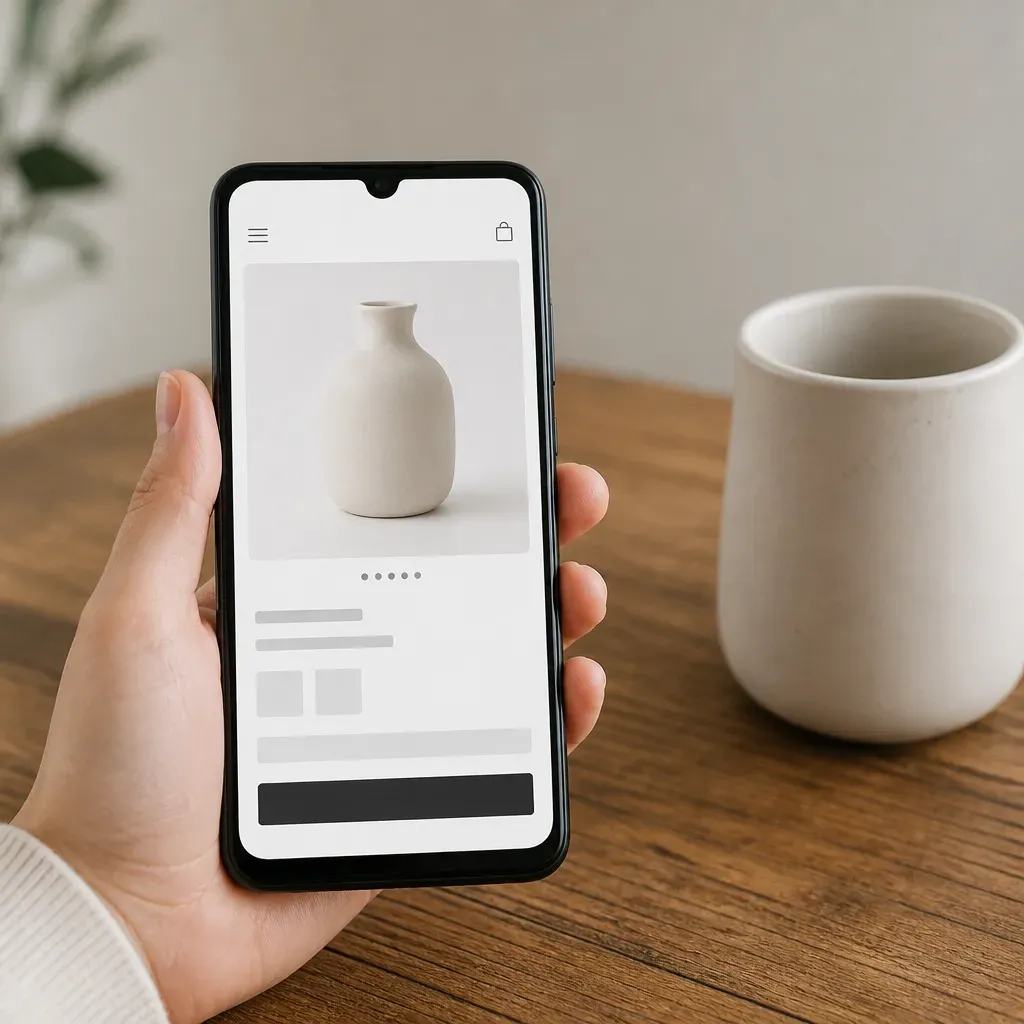
Place a tap-to-call link and a WhatsApp Business link in the mobile header, and keep the primary action visible without scrolling. Use one primary action per screen. Two equally weighted buttons split attention and make conversion measurement ambiguous.
Forms That Get Completed
Limit fields to what the team needs to qualify a request. A name, a phone number, and one service selector are usually enough. For clinics and venues where a callback is the real next step, put the phone field first. Accept local number formats without forcing the international prefix, because forced formats are a common source of abandoned submissions.
QR Entry Points for Venues
For cafés, gyms, and event venues, a QR code on a table or wall sign can open a mobile web page without an app download. MizaOS, the venue platform Miza is developing, opens its customer web experience this way. The page must load quickly on the first scan, avoid a login wall, and show the offer or menu on the first screen. Test the code from several distances and under the actual lighting of the venue before printing.
Content Architecture and Service Pages
Site structure should follow the questions customers ask, not the internal organization chart. A clinic needs a page for each service, the specialists who provide it, and location and hours. A school needs separate pages for admissions, programs, fee structure, and enrollment steps. Each page should answer one search intent.
One Page per Service with Defined Scope
Each service page should state the deliverable, the typical timeline range, the information the client must provide, and what is excluded. Generic pages titled with broad labels such as “Our Solutions” generate support load, because prospects call to ask what the page does not say.
Arabic Search Terms and Local Intent
Arabic search queries differ from literal translations of English keywords. Build the keyword list from the Arabic phrases customers actually type, including dialect variants, and map each phrase to one page. Use Baghdad in titles and headings where the business serves that city, but do not repeat the city name mechanically in every paragraph.
Metadata, Hreflang, and Indexing
Set unique title tags and meta descriptions for each language version, add hreflang annotations between Arabic and English pages, and submit an XML sitemap. Verify that Arabic pages do not canonicalize to their English counterparts. That configuration error quietly removes the Arabic pages from the index.
Choosing Your Build Approach
The build approach determines who can edit content, how fast the site loads, and what it costs to keep running. Three approaches are common in Iraq: a hosted website builder, a self-managed CMS installation, and a custom-built site connected to the business’s own systems. Each suits a different operational profile.
| Approach | Strengths | Trade-offs |
|---|---|---|
| Hosted website builder | Fast to launch, low initial cost, simple content editing | Limited control over RTL edge cases, performance tied to the platform, restricted export options |
| Self-managed CMS such as WordPress | Large plugin ecosystem, familiar to most editors and developers | Plugin sprawl, a continuous update burden, and performance that depends heavily on hosting and plugin choices |
| Custom build connected to business systems | Lean code, tailored Arabic layouts, and orders or customers synchronized with the back office | Higher upfront scope, and it requires a documented handover and a maintenance agreement |
Choose by workflow rather than feature list. If orders, appointments, or loyalty points must reconcile with a back office, a standalone builder usually creates manual reconciliation work. Miza builds custom systems around each client’s daily workflow, which is why this comparison starts with the operation rather than the template.
Three Questions That Narrow the Options
Ask who edits content weekly, which systems the site must exchange data with, and who holds the hosting account. The answers eliminate most options quickly. A site that only one external contractor can edit is a dependency, not a system.
Pro tip: Ask the vendor to export the complete site, including media files and form submissions, before signing. If the export is incomplete, you are renting a website rather than owning one.
Maintenance and Post-Launch Ownership
Most websites degrade after launch because no one owns the updates. Security patches are skipped, the SSL certificate lapses, and content stays frozen for years. Treat maintenance as a line item in the contract, with a named owner on both the client and vendor side.
Domain, Hosting, and Credentials
Register the domain in the business’s legal name, with the account email controlled by the company rather than an individual’s personal address. Store admin credentials in a shared password manager with at least two named administrators, and document where DNS is managed and who can renew it.
Backups and Restore Testing
A backup that has never been restored is an assumption. Schedule automated daily backups stored away from the hosting server, and test a restore to a staging copy at least once per quarter. Record how long the restore took, because that figure determines how long an outage lasts.
Analytics Tied to Contact Actions
Connect analytics to contact actions rather than page views alone. Track phone taps, WhatsApp clicks, and completed forms as events. Review them monthly, and change one element at a time so that any shift in results can be attributed to a specific change.
Frequently Asked Questions
How should I compare web design quotes for a Baghdad business?
Ask every vendor for a line-item breakdown covering design, Arabic and English content, payment or form integrations, hosting, and a post-launch maintenance fee. A quote that omits hosting or maintenance is not comparable to one that includes them, even when the headline figure is lower.
Should I build one bilingual site or separate Arabic and English sites?
One site with separate language versions under distinct URLs, linked with hreflang annotations, is the usual approach. Separate domains split search authority and double the maintenance workload. Separate sites make sense only when the audiences are entirely distinct.
Is a website builder enough for a small shop in Iraq?
It can be enough when the catalog is small, editing is simple, and orders do not need to sync with other systems. Before committing, verify RTL behavior, cash on delivery configuration, and export options. Migrating later usually costs more than the difference in the initial build.
Which payment options should a Baghdad website offer?
Offer cash on delivery and the wallet methods your customers already use, such as ZainCash, FastPay, Qi Card, or AsiaHawala, depending on your category. Confirm integration steps and settlement terms with each provider before launch, not after the first order.
How often should a business website be maintained?
Security and framework updates should be applied within days of release rather than on a quarterly schedule. Hours, prices, and offers should be reviewed monthly. Backups should be restored to a staging copy at least once per quarter to confirm they work.